Highlights contain the inclusion of the high-frequency “Silver Line,” visible through the thick trunk that runs from Penn Medicine Station to Jenkintown-Wyncote.
The map brings back the simplified line pairings of the original S-Bahn concept that coincided with the opening of the Center City Commuter Connection (CCCC) back in 1984.
No word on how long the feedback form will be open.
With the recent re-re-opening of PATCO’s Franklin Square Station, it felt like a good time to revisit the Philadelphia Rapid Transit Timeline. I’ve updated the timeline to include Franklin Square’s reopening and added the proposed Roosevelt Boulevard Subway to the timeline. I’ve also made several corrections.
About a week ago, I came across a reddit post displaying the timeline of Washington DC’s Metro development. Needless to say, I set out to create a similar graphic for Philadelphia.
The Philadelphia Rapid Transit Timeline spans 145 years, three transit authority eras and four lines that qualify as rapid transit. The majority of development happened prior to World War II with 54 stations being opened before 1940. Since then, another 27 stations have opened, the majority of them being related to PATCO.
No station has opened since the Broad Street Spur’s Chinatown Station replaced Vine Street in construction necessitated by the building of the Commuter Rail tunnel in the 1980s.
Philadelphia’s Transit Plan vision for 2045 does include several projects that have been added to the timeline as proposals. Only the reopening of the Franklin Square station on the PATCO line seems guaranteed at this point.
Check out the timeline, and of course, let me know if you have any corrections or comments.
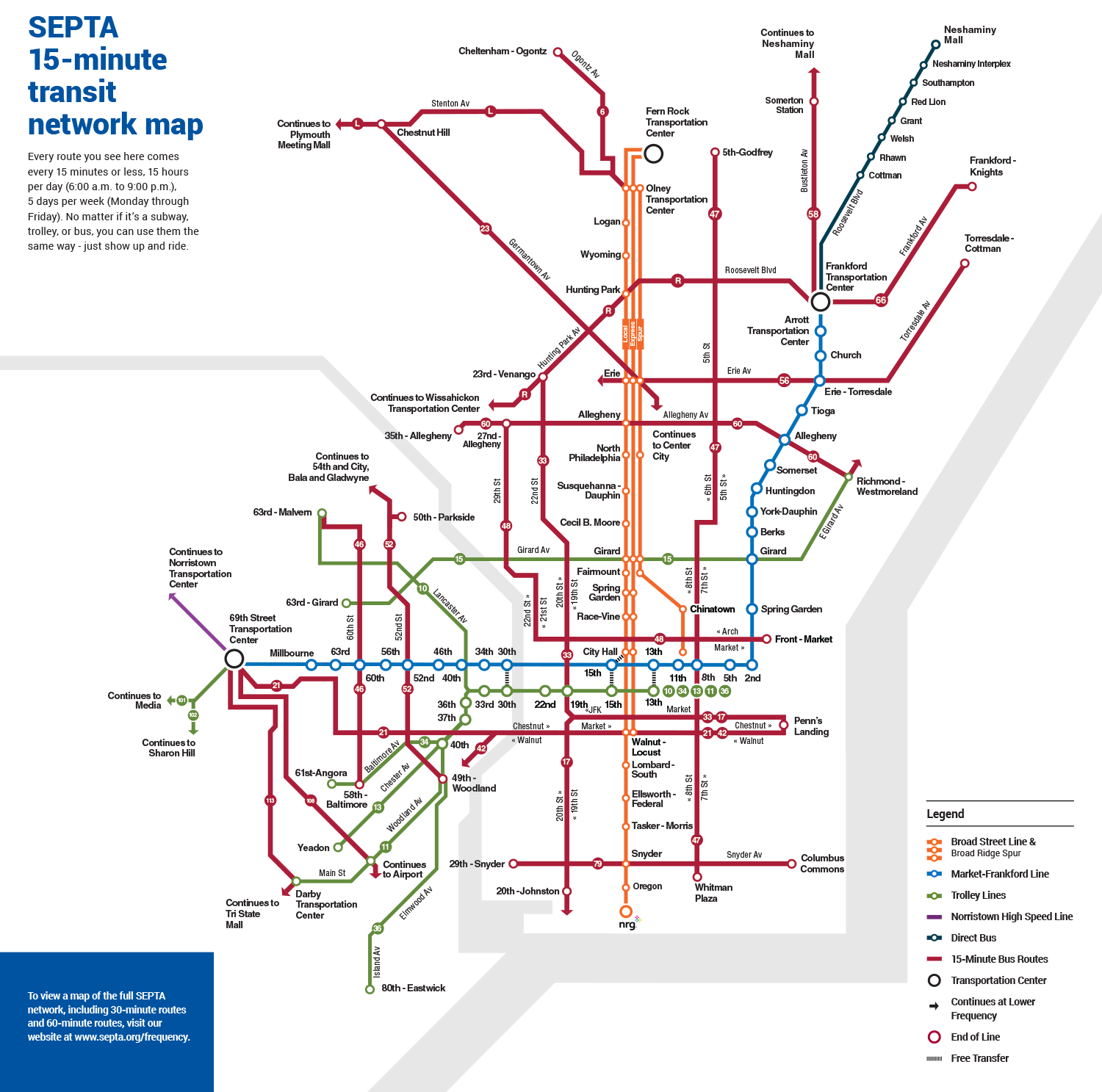
SEPTA is redesigning its transit maps and way-finding systems. As part of the effort, the transit authority is sharing some SEPTA maps done in the style of other transit systems from around the world in a feature they’re calling Transit Map Tuesday.
The work is evidently being done by SEPTA’s Strategic Planning intern and they have done a fine job through two weeks. For week one, the inspiration was the iconic Transport for London’s Tube map. That’s been followed up with Boston’s MBTA map, and includes frequent bus lines in addition to the rapid transit lines.
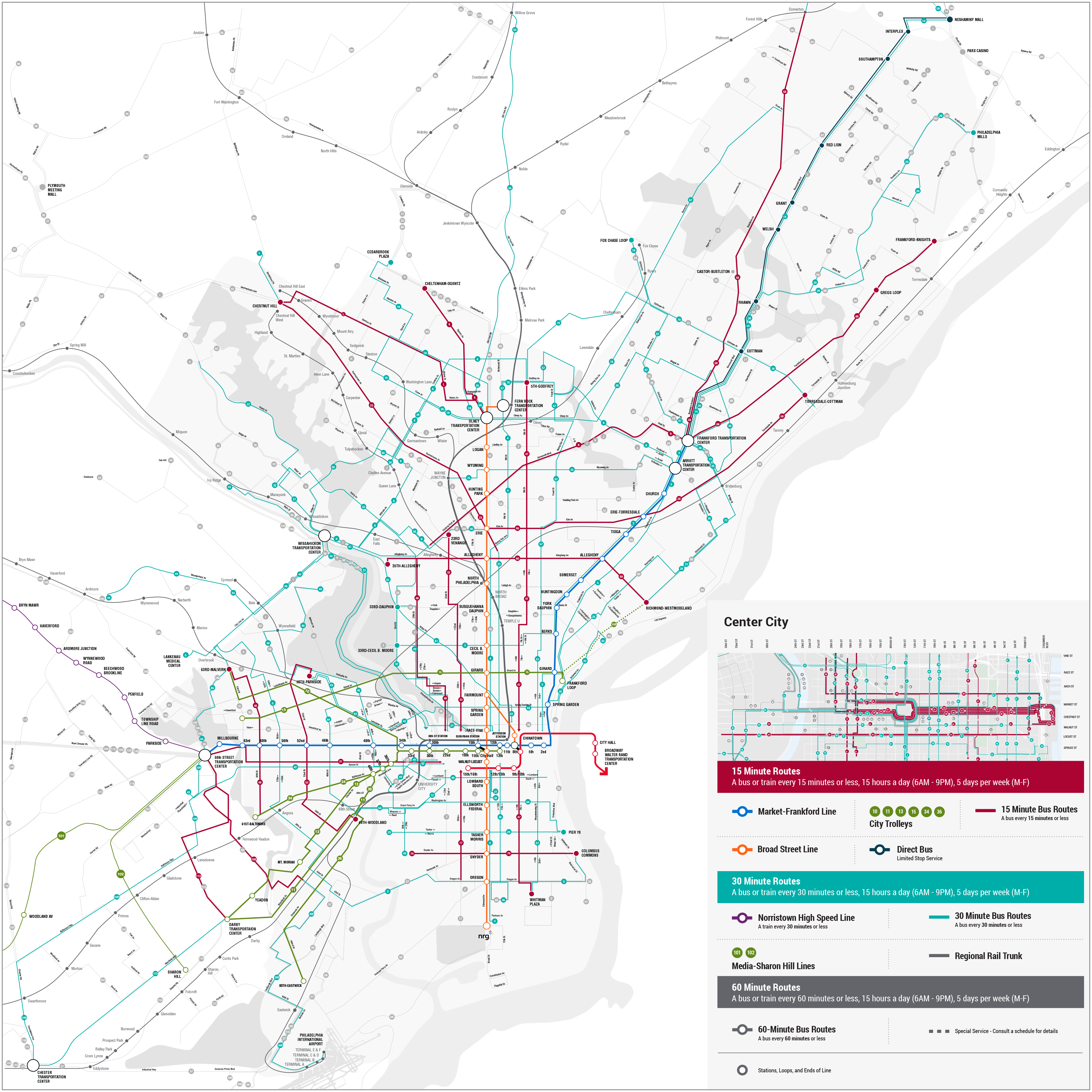
Back in February SEPTA updated its bus map, attempting to show regional rail, subway, elevated rail, trolleys and buses all on the same map. Additionally the map showed frequency of bus transit via color and thickness of lines. SEPTA then asked for comment on the new maps to flavor the next round of maps.
It’s actually two maps that have been released. The first is a new system map showing the 80+ bus routes that connect with the city of Philadelphia. The most frequent routes are shown in red, the routes that run every thirty minutes or less are in teal and those that run every 60 minutes or less are denoted in gray.
The maps are posted to SEPTA’s website and a survey is provided for feedback. This is the latest step in SEPTA’s reworking of its bus network.
The overall SEPTA system map has long been maligned as a “blobby mess.” Transit Maps gave the 2011 edition of the map a stinging one-and-a-half star rating.
SEPTA should feel lucky that no one has rated their line maps for the Broad Street line or Market-Frankford line. These are abominations in their own right. No consistency with the overall system map, confusing letters, colors and variable thickness in lines all gather to lessen the usability of the system.


You must be logged in to post a comment.